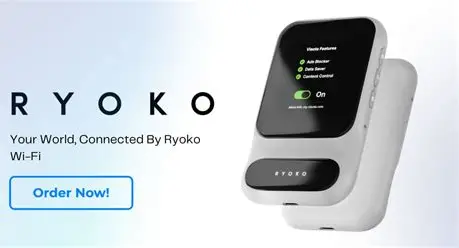
If you’re looking at the Ryoko Global / Viaota hotspot, the important thing to understand is that you’re really buying two products: a small 4G travel hotspot and Viaota’s international cellular-data service. That makes the data plan just as important as the hardware.
SōLIS HS600000 Lite 4G LTE Global Wi-Fi Hotspot
$89.00
GL-E750V2 MUDI 4G LTE Portable Wi-Fi Hotspot
$289.92
Ryoko Global Viaota Hotspot Review: Convenient Worldwide Internet, With a Big Catch
Rating: 7.5/10
The Ryoko Global Wi-Fi Hotspot is designed for travelers who want a simple way to get online without constantly swapping SIM cards, buying local data plans, or paying their phone carrier’s international roaming fees.
The concept is excellent.
Turn on the Ryoko, connect your phone, tablet or laptop, and Viaota’s service automatically connects to an available cellular network. Viaota says the service works in 150+ countries, while its main website currently describes access to more than 350 networks across 71+ countries/regions. The company says the hotspot can connect up to 10 devices and delivers 4G LTE speeds of up to 150 Mbps under suitable network conditions.
The problem is that the marketing term “unlimited” needs a very large asterisk.
Viaota’s current terms state that unlimited plans are throttled after 15GB in a monthly billing cycle, with speeds reduced to 256 Kbps for the remainder of the cycle. The company also reserves the right to restrict service for excessive usage.
That dramatically changes my assessment.
Design: Small and Travel-Friendly
The Ryoko is built around portability rather than raw performance.
It’s essentially a dedicated cellular modem/router that creates its own private Wi-Fi network. Your phone, laptop, tablet or other Wi-Fi devices connect to Ryoko rather than directly to a cellular carrier.
That’s particularly useful when traveling with multiple devices.
Instead of:
Phone SIM → roaming plan
you get:
Ryoko → cellular network → private Wi-Fi → all your devices
Viaota says up to 10 devices can connect simultaneously.
The device also has a screen that displays useful information such as signal strength, connected devices and battery level. The included SIM is already installed, so setup is considerably easier than dealing with a loose SIM card.
Design score: 8.5/10
Setup: One of Its Strongest Features
Setup is straightforward.
Turn on the Ryoko, and you can connect either by scanning the QR code displayed on the device or by selecting the Ryoko Wi-Fi network and entering the displayed password.
There is also no requirement to install a dedicated mobile app. Viaota instead uses its online portal for managing the account and data.
For international travel, that’s a nice advantage.
You don’t have to:
- Find a SIM store
- Remove your phone’s SIM
- Figure out local carrier settings
- Create another account with a foreign carrier
- Configure your phone’s hotspot
- Give your primary phone number to a local carrier
The simplicity is the whole point.
Setup score: 9/10
International Connectivity
This is where Ryoko becomes interesting.
Viaota says Ryoko automatically selects the strongest available local network and can be used across more than 150 countries.
That means you can theoretically travel through several countries with the same device and data account.
For example:
USA → France → Germany → Italy → Japan
without having to buy a new physical SIM at each destination.
That’s much more convenient than traditional travel SIMs.
However, “global coverage” should not be interpreted as guaranteed connectivity everywhere.
Ryoko ultimately depends on cellular networks in the area you’re visiting. If the local network has poor coverage, congestion or no service at your location, Ryoko can’t magically create a signal.
That becomes especially important in rural areas.
One Reddit user reported good performance in metropolitan areas but poor results while camping in Acadia National Park.
That’s consistent with what you’d expect from any cellular hotspot: the modem isn’t the limiting factor when there’s no good tower nearby.
Connectivity score: 8/10
Speed: Good for Travel
Viaota advertises up to 150 Mbps on 4G LTE, depending on local network conditions.
That’s plenty for:
- Web browsing
- Google Maps
- Social media
- Remote work
- Video calls
- Music streaming
- Normal HD video streaming
It can also serve several devices simultaneously.
But I wouldn’t buy Ryoko expecting it to replace a fast home broadband connection.
It’s fundamentally a travel connection.
And Viaota’s own terms explicitly state that its service isn’t intended to replace permanent home or office broadband.
Performance score: 8/10
The “Unlimited” Problem
This is the biggest issue with Ryoko.
Viaota currently advertises an Unlimited Pro Plan for $24.95/month promotional pricing, compared with a listed regular price of $49.90/month.
At first glance, that sounds pretty good.
But the company’s terms say unlimited subscribers receive:
15GB at full speed → 256 Kbps afterward
for the remainder of the monthly cycle under one of the current unlimited-plan throttling structures.
The terms also say that once total monthly usage exceeds 40GB, the account can be flagged for review and potentially restricted or suspended.
That’s a major limitation.
At 256 Kbps, normal modern internet use becomes painful.
You can still theoretically send messages and perform basic web tasks, but:
- HD video streaming becomes impractical
- Large downloads become extremely slow
- Cloud backups are essentially unusable
- Software updates become painful
- Video conferencing can become problematic
So I would not describe this as truly unlimited high-speed internet.
It’s better described as:
15GB of high-speed data with throttled unlimited service afterward.
That’s a much more accurate description for a buyer.
Data Plans
Viaota currently lists:
| Plan | Promotional price | Data |
|---|---|---|
| 3GB Pro | $9.99/mo | 3GB |
| 5GB Pro | $14.99/mo | 5GB |
| 10GB Pro | $19.99/mo | 10GB |
| Unlimited Pro | $24.95/mo | 15GB high-speed, then throttled |
The promotional prices shown by Viaota are currently 50% off listed regular rates.
There’s another important detail: these are recurring subscriptions unless canceled.
Viaota’s terms say subscriptions automatically renew until canceled.
That’s something I’d pay close attention to during checkout.
Battery Life
Viaota rates Ryoko for up to eight hours of use.
That’s acceptable rather than exceptional.
Eight hours is enough for:
- A day of sightseeing
- A workday with moderate use
- A long flight connection
- Road trips
- Restaurant/café hopping
But if you’re traveling all day, you’ll probably want a power bank.
This is particularly true if you’re connecting multiple devices or using the hotspot continuously.
Battery score: 7.5/10
Built-In Ad Blocking Is Surprisingly Interesting
One unusual feature is Viaota’s network-level ad and security filtering.
With the included Viaota SIM, Ryoko can provide automatic blocking of known advertising networks, trackers, malware and phishing sites.
That’s a nice bonus.
It’s particularly useful when you’re traveling because you may be connecting to unfamiliar networks and websites.
However, Viaota warns that legitimate sites can occasionally be affected, in which case the feature can be disabled.
Security: Better Than Public Wi-Fi
There’s a real advantage to carrying your own hotspot.
Instead of connecting your laptop to:
Hotel Wi-Fi → shared network
you connect:
Laptop → private Ryoko Wi-Fi → cellular network
Viaota specifically recommends using Ryoko rather than open public Wi-Fi for sensitive activities such as banking and shopping.
I wouldn’t treat that as a replacement for a VPN or comprehensive security practices, but a personal cellular hotspot is certainly preferable to an unknown open Wi-Fi network.
The Service Is Not Perfect
This is where the online feedback becomes mixed.
Ryoko/Viaota has a very large number of Trustpilot reviews. The current Trustpilot profile shows a 4.3/5 rating from more than 26,000 reviews, with many customers praising the device’s convenience and international connectivity. However, the same review summary notes complaints involving unexpected costs, connection problems and difficulty getting devices working.
There are also recent negative reports concerning throttling and support.
For example, one September 2026 Trustpilot review described bandwidth problems while camping and frustration dealing with support.
Reddit discussions are similarly mixed: some travelers report that Ryoko works well, while others complain about throttling, poor support or unreliable connections.
I wouldn’t characterize Ryoko as universally unreliable—the volume of positive reviews argues against that—but your experience can vary considerably based on location, cellular coverage and data usage.
Recurring Billing Deserves Attention
This is another area where I’d be careful.
Viaota’s terms state that subscriptions automatically renew, and the company can change subscription pricing with at least 14 days’ notice.
The terms also state that unused service isn’t converted to cash when a subscription is terminated.
That’s not unusual for subscription services, but it’s worth knowing before signing up.
My advice:
If you’re only traveling occasionally, don’t automatically choose the recurring plan without checking the cancellation and renewal terms.
Ryoko vs. Using Your Phone’s Hotspot
This is the most important comparison.
Your phone wins when:
- You’re primarily using one device
- Your carrier includes international roaming
- You already have a generous hotspot allowance
- You’re traveling somewhere your carrier has excellent roaming coverage
Ryoko wins when:
- You’re traveling internationally
- You have several devices
- Your carrier’s roaming is expensive
- You don’t want to drain your phone battery
- You want a dedicated travel connection
- You’re moving through multiple countries
The biggest benefit isn’t necessarily faster internet.
It’s convenience.
Ryoko vs. Local SIM/eSIM
This is a much tougher comparison.
A local SIM/eSIM will often provide:
more data + higher speeds + better pricing
if you’re staying in one country for an extended period.
Ryoko’s advantage is simplicity.
If you’re going to spend two weeks in Japan, a Japanese eSIM may be a better deal.
If you’re going:
Japan → South Korea → Singapore → Thailand → France
Ryoko becomes considerably more attractive because you don’t have to manage four separate cellular plans.
Who Should Buy Ryoko?
Buy it if you:
- Travel internationally several times a year
- Visit multiple countries on one trip
- Need internet for multiple devices
- Don’t want to swap SIMs
- Have expensive carrier roaming
- Want a dedicated travel hotspot
- Mostly need moderate amounts of data
Skip it if you:
- Need more than 15GB of high-speed data every month
- Want 5G performance
- Need a replacement for home broadband
- Mostly travel in one country
- Already have excellent international roaming
- Spend significant time in remote areas without cellular coverage
Pros
- Excellent travel-oriented concept
- Works across many countries
- No need to swap SIM cards
- Connects up to 10 devices
- Simple setup
- Built-in screen
- Up to 150 Mbps advertised 4G LTE
- Up to 8 hours battery
- Network-level ad/tracker blocking
- Private Wi-Fi connection
- Convenient for multi-country trips
Cons
- “Unlimited” is heavily qualified
- 15GB high-speed threshold is restrictive
- 256 Kbps throttling is extremely slow
- No 5G according to current specifications
- Cellular performance depends on local networks
- Battery life is merely average
- Subscription automatically renews
- Some users report support/connectivity problems
- Local SIM/eSIM can be considerably cheaper for single-country travel
Final Verdict
The Ryoko Global Viaota Hotspot is a good travel gadget attached to a service plan that needs careful reading.
The hardware itself is convenient. The ability to turn on one small device and connect up to 10 devices across international destinations is genuinely useful.
For a frequent traveler, that’s compelling.
But I have a much harder time recommending the service as a primary internet connection because of Viaota’s current throttling policy.
The word “unlimited” is the biggest problem.
If you’re getting 15GB of high-speed data and then dropping to 256 Kbps, you’re not getting unlimited high-speed internet. That’s perfectly reasonable for occasional travelers who use relatively little data, but it becomes a serious limitation for heavy users.
Final Score: 7.5/10
| Category | Score |
|---|---|
| Design | 8.5/10 |
| Setup | 9/10 |
| Portability | 9.5/10 |
| International Coverage | 8/10 |
| Speed | 8/10 |
| Battery | 7.5/10 |
| Security/Features | 8/10 |
| Data Plans | 6.5/10 |
| Value | 7/10 |
| Overall | 7.5/10 |
Bottom line
For international travelers: 8/10.
For heavy data users: 5.5/10.
As a home-internet replacement: 3/10.
I’d buy Ryoko primarily for convenience while traveling internationally, not because it offers the cheapest or fastest mobile data.
And before buying, I’d look very carefully at the 15GB high-speed limit, automatic renewal, current promotional price, and cancellation terms. Those details matter considerably more than the hotspot’s advertised maximum speed.